
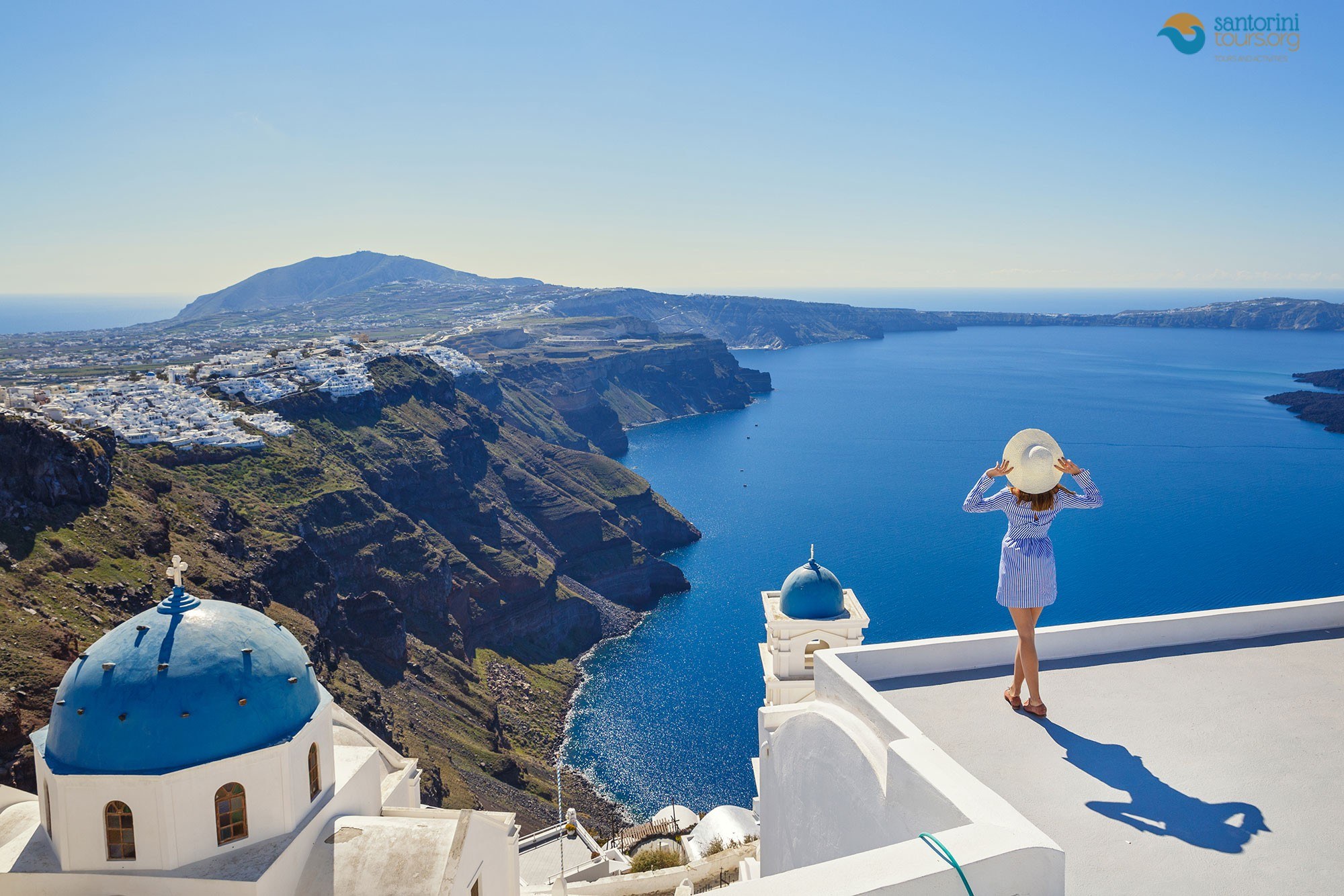
Santorini is eighteen kilometres long and takes most of a day to see properly. That contradiction is the whole planning problem. The map suggests you could drive the island in ninety minutes; the reality is a single coastal road, a handful of pinch points, and villages built vertically into a cliff where every stop involves stairs.
This guide is about the route rather than the booking. Which stops earn their place, what order to take them in, how the crowds move through the day, and how the best santorini tours are sequenced to arrive everywhere at the right hour. If you know what you want to see and are working out how to fit it together, this is the part that decides whether the day works.
For travellers planning the island, santorini tours and santorini tours offer expertly guided experiences across Santorini — from caldera sunsets and volcano walks to private wine tastings and tailor-made sightseeing.
What Is The Best Route For Santorini Tours?
Oia first thing, the south and Akrotiri through the middle of the day, a winery in the late afternoon, and a caldera viewpoint that is not Oia at sunset. This runs counter to almost every published itinerary, which is exactly why it works.
The standard circuit used by most santorini tours starts in Fira, works north to Oia for late afternoon and finishes there at sunset. Every coach on the island does this. Santorini tours that invert it see the same places at a third of the density: Oia at nine in the morning is quiet enough to photograph, and Imerovigli at sunset has the same sun over the same caldera with a fraction of the crowd.
The middle of the day belongs to the south because Akrotiri is roofed and shaded while the villages are not. Putting the archaeological site at noon and the clifftop walking at either end of the day is the single biggest comfort decision in the whole route.
How Long Does It Take To Cross The Island?
Fira to Oia is 11 km and takes 25 minutes at dawn, 50 or more at four in the afternoon. Fira to Akrotiri is 30 minutes; Fira to Perissa about 25.
These numbers are why santorini tours itineraries collapse. Six stops on a seven-hour day looks generous until two and a half hours have gone to driving and another forty minutes to parking. Well-built santorini tours budget travel honestly and end up with five stops that feel unhurried rather than eight that feel like a bus tour.
The pinch points are consistent: the junction above Fira, the descent into Oia, and the single road serving the Ammoudi steps. Anything routed through those between 15:00 and 19:00 will be slow.
Which Stops Are Genuinely Essential?
Oia, Imerovigli, Akrotiri and one traditional inland village. Everything else is a legitimate preference rather than a requirement.
That shortlist covers the four things santorini tours exist to show you: the postcard village, the caldera view, the Bronze Age catastrophe that shaped the island, and the ordinary Cycladic life that continues away from the rim. Most santorini tours that disappoint have substituted a beach or a photo stop for one of those four.
What Is Oia Actually Like, And When Should You Go?
Extraordinary before 10:00, difficult after 16:00, and genuinely unpleasant in the ninety minutes before sunset in high season.
On santorini tours the village is a run of whitewashed lanes along a clifftop, with the blue-domed churches on the northern edge and the ruined castle at the western tip where the sunset crowd gathers. It is beautiful and it is famous, and the second fact now substantially shapes the first.
Early morning is a different village entirely: bakeries opening, the marble still cool, the domes photographable without waiting. Santorini tours that place Oia first are making the most valuable single decision available to them. The Ammoudi steps below the village — around three hundred of them down to the fishing harbour — are worth it for the taverna at the bottom, but not in the middle of the day and not in sandals.
Read more: Santorini North Part Tour
Why Is Imerovigli Better Than Oia For Sunset?
Same sun, same caldera, higher vantage point, a fraction of the people, and you can leave afterwards without queueing.
Imerovigli sits at the highest point of the caldera rim and is known locally as the balcony of the Aegean. Skaros Rock juts out below it — a Venetian fortress site reachable on a short, steep path — and the view north takes in Oia itself, lit up on its own headland.
The practical argument for santorini tours ending here is the exit. After sunset several thousand people leave Oia along one road, and a taxi at that moment is essentially unobtainable. Santorini tours ending at Imerovigli or Profitis Ilias drive away in five minutes. This is the difference between a day that ends well and one that ends in a car park.
Is Akrotiri Worth Half Of Your Afternoon?
Yes. It is the most significant archaeological site in the Cyclades and the strongest single reason to take a guided rather than a self-directed day.
Akrotiri was a sophisticated Bronze Age town — multi-storey buildings, drainage systems, frescoes, evidence of trade across the eastern Mediterranean — buried under volcanic ash around 1600 BC and preserved by it. On santorini tours the site is roofed, level and walkable in about an hour.
Unguided it is a set of stone walls behind rope. Guided it is a functioning town with streets you can follow, and the volcanic eruption stops being scenery and becomes the event that ended it. Nearly all full-day santorini tours include it; the ones that do not are usually sunset-focused routes with a different purpose.
Which Inland Villages Should Be On The Route?
Pyrgos first, then Megalochori, then Emporio. These are where the island’s ordinary life continues, and they are consistently the stops first-time visitors are surprised to have loved.
Pyrgos
A medieval hilltop village of stepped lanes spiralling up to a Venetian castle, with a 360-degree view from the top taking in both coasts and, on a clear day, the neighbouring islands. It was the island’s capital before Fira. Quiet, lived-in, and about twenty minutes from most of the caldera.
Megalochori
Neoclassical mansions built on wine money, bell towers standing free in small squares, and wine caves cut into the pumice below the houses. It photographs beautifully and takes half an hour to walk. Santorini tours heading between Akrotiri and the wineries pass directly through it.
Emporio
The island’s largest medieval kasteli — a defensive maze of interlocking houses built to present a blank outer wall to pirates. Most groups skip it entirely, which is precisely the argument for going.
Read more: Santorini Private Custom Tour
Where Do The Wineries Fit In The Day?
Late afternoon, between the last village and the sunset viewpoint. For santorini tours the light is good, the heat has dropped, and a tasting works better as a wind-down than as a mid-morning stop.
Santorini’s Assyrtiko grows on vines woven into low circular baskets pressed against the volcanic soil, a technique developed over centuries to survive wind and drought and found almost nowhere else. The wines are mineral, bone-dry and unlike anything from mainland Greece. Most wineries cluster around Pyrgos, Megalochori and the road south, which is why santorini tours built anticlockwise end up passing them at exactly the right hour.
The other reason a tasting belongs on a guided day is legal: Greece’s blood-alcohol limit is 0.05%, and a route of three wineries is not compatible with driving.
Which Beaches Are Worth Building Into The Route?
Perissa or Kamari if you want to swim, Vlychada if you want the photograph, Red Beach as a viewpoint rather than a swim.
Santorini’s beaches are volcanic — black, red and grey sand, sometimes coarse pebble — dramatic rather than soft. Kamari and Perissa sit on the east coast beneath the vast rock of Mesa Vouno, with full taverna and sunbed infrastructure and the island’s easiest swimming.
Vlychada’s wind-sculpted white cliffs look genuinely lunar and are the most photogenic stretch of coast on the island. Red Beach, near Akrotiri, is spectacular and periodically closed for rockfall risk, so most santorini tours now view it from the marked overlook above rather than descending.
What Does The Caldera Actually Look Like From The Water?
Completely different — the cliffs become the spectacle instead of the platform, and the scale of the collapse finally reads.
On boat santorini tours, instead of standing on the rim edge of a volcanic crater looking across it. From a boat in the middle you are inside it, with 300-metre cliffs banded in red, black and white rising on three sides. It is the single view that explains the island’s geology without anyone having to narrate it.
Catamaran santorini tours typically run five to six hours with swimming stops near the Red and White beaches, a pass by the hot springs, a meal on board and sunset from the water beneath Oia. If you only add one thing to a land itinerary, this is it.
Is The Volcano Walk Worth Including?
Yes for the geology, no if you are expecting a spa. Nea Kameni is the active cone in the middle of the caldera, and the walk to the crater rim takes about thirty minutes uphill on loose volcanic gravel with no shade at all.
The landscape at the top is grey, lunar and genuinely strange, with steam still venting from fissures. Closed shoes are essential. The hot springs off Palea Kameni that follow are a patch of ochre-tinted sea around 30°C which permanently stains light-coloured swimwear. Among santorini tours this is the only one that puts you physically on the volcano that made the island, and set against honest expectations it is excellent.
Read more: Santorini Sightseeing Tour
What Is Thirassia And Should You Go?
The piece of the original island left standing across the caldera when the volcano collapsed — about two hundred residents, no crowds, and the closest thing to Santorini fifty years ago.
It appears on relatively few itineraries and is the single most common recommendation from people who have visited the island more than once. Boat santorini tours combining the volcano, the hot springs and Thirassia make a full day that covers the geology and the pre-tourism island in one run.
How Does The Fira To Oia Hike Compare To Driving It?
Ten kilometres along the caldera rim with continuous views, three to four hours, and the best thing on the island for anyone willing to start at dawn.
The path runs from Fira through Firostefani and Imerovigli, climbs behind Skaros, crosses open volcanic hillside and drops into Oia. The hike is not technical, but unlike vehicle-based santorini tours it is exposed, undulating and completely shadeless. In July and August it should be started before seven or not at all.
It pairs naturally with a one-way transfer: walk out, get driven back. Operators running santorini tours arrange exactly this, and it is a far better use of a morning than the same stretch seen through a window.
What Is The Best One-Day Itinerary?
08:30 Oia · 10:30 Imerovigli and Skaros · 12:00 Akrotiri · 13:30 lunch at Vlychada · 15:30 winery near Pyrgos · 17:00 Pyrgos village · 18:45 sunset at Profitis Ilias.
Seven stops on santorini tours, about ten hours, and every one of them hit at the hour that suits it. The two crowded places are visited at their quietest, the roofed site takes the midday heat, and the day ends somewhere you can leave. Most private santorini tours will build something close to this on request, and it remains the best single day the island offers.
What Is The Best Two-Day Plan?
Day one on land as above; day two at sea on a catamaran departing mid-afternoon.
The second day of santorini tours covers what the first cannot: the caldera from inside, the swimming stops, the hot springs, and sunset from the water. Two days built this way cover the island’s full range with no repetition, and they leave a third day genuinely free — which is the part most visitors under-value until they have spent one.
What Does A Three-Day Plan Add?
A slow day, not a third tour. Beach in the morning, an inland village in the afternoon, dinner somewhere with a view.
Read more: Santorini Semi Private Small Group Sightseeing Private Tour
Travelers who book three consecutive santorini tours consistently report that the third blurred into the second. The island’s pleasure is substantially in sitting still on a terrace watching the light move across the caldera for two hours, and a schedule with no gap removes exactly that. Two booked experiences and one open day is the right ratio on a short stay.
How Do Cruise Passengers Fit This Into One Day?
Three substantial stops, a ninety-minute buffer before all-aboard, and no attempt at the full circuit.
The realistic cruise-day route for santorini tours is Oia, then either Akrotiri or a winery, then a caldera viewpoint, then back to the port well ahead of the queue. The constraint is not the roads — it is the cable car and tender boats at the old port, which on a three-ship day can absorb an hour by themselves.
Shore-focused santorini tours build that buffer in and know which queue to join. Give the operator your ship name and all-aboard time when booking rather than on the morning.
Where Are The Best Viewpoints That Are Not Oia?
Profitis Ilias, Skaros Rock, the Three Bells of Fira, Firostefani’s paved rim, and the Pyrgos castle roof.
Profitis Ilias is the island’s highest point, with a monastery at the top and a panorama covering both coasts and the whole caldera. Skaros is the dramatic one, reached on a short steep path from Imerovigli. The Three Bells of Fira, below the Firostefani path, is the most photographed church on the island and best shot in the morning with the light behind you.
These are the stops that separate thoughtful santorini tours from the standard circuit, and none of them carry a crowd comparable to Oia’s.
When Is The Best Time Of Year For This Route?
Late April to mid-June, and September to late October. Warm enough to swim, long enough in daylight, without the July–August density that turns every viewpoint into a negotiation.
High summer is hot, busy and expensive, but the sea is warmest and the sunsets most reliable. If those are your dates the answer is not to avoid santorini tours but to start them earlier than feels natural. Winter empties the roads and drops the prices, but many wineries, beach tavernas and all boat operators close from November to March.
How Does The Crowd Move Through The Day?
Light until ten, heavy from eleven to two, easing until four, then compressing hard into the sunset window.
Read more: Santorini Full Day Tour
That curve, which santorini tours are built around, is driven by cruise arrivals and hotel breakfast times, and it is remarkably consistent. Knowing it is most of what separates a well-sequenced day from a frustrating one. Santorini tours that start at eight are ahead of it all day; the same route starting at ten is behind it all day, for the same money.
Checking the cruise schedule for your dates costs nothing and changes the plan more than any other single piece of information. A no-ship day and a five-ship day are different islands.
What Do Most Itineraries Get Wrong?
Too many stops, the wrong direction, and no plan for leaving Oia after sunset.
Santorini from the air: the caldera, the villages and the cliffs.
Nine stops on santorini tours in a seven-hour day means twenty minutes at each and no memory of any of them. Running the standard clockwise circuit puts every stop at peak density. And arriving in Oia for sunset without a vehicle arrangement leaves you competing for a taxi with several thousand people in a village served by one road.
None of these are subtle, and all of them are common. The fix in each case is structural rather than expensive, which is why comparing santorini tours on itinerary quality matters more than comparing them on price.
Can You Combine Santorini With Nearby Islands?
Ios, Naxos, Paros and Milos are all within a two-hour fast ferry, and Thirassia is a twenty-minute crossing.
Day-trip santorini tours to Thirassia and the volcanic islets run daily in season. A full island-hop beyond santorini tours needs an overnight to be worth it, but the caldera islets are a comfortable half or full day and add the one perspective the rim cannot give you.
What Should You Wear And Carry On This Route?
Closed shoes with grip, two litres of water per person, sun protection, a wind layer, and cash in small notes.
On santorini tours the lanes are polished marble and steeper than they photograph; the volcano path is loose gravel; the caldera steps run in both directions. Footwear is the highest-leverage item on the list. The island is arid with almost no shade at the archaeological sites, so water matters more than visitors expect.
The wind layer surprises people: the meltemi blows hard from the north through the summer and a caldera viewpoint at sunset is markedly colder than the afternoon before it. Boat-based santorini tours are colder again once the sun drops.
Read more: Santorini Sunset Tour
How Do Santorini Tours Handle Families With Children?
By choosing the format first: private vehicles and boats work, long walking-heavy village circuits do not.
On family santorini tours the practical obstacles are heat, stairs and waiting. Santorini’s villages are built vertically, with a great many steps and few flat stretches, and a mid-afternoon queue at a viewpoint is where a family day comes apart. A private vehicle solves most of it by allowing shorter stops and an air-conditioned base in between.
Boat-based santorini tours are usually the family favourite outright: swimming breaks, food on board, a fixed seat and no walking at all. For a mixed-age group the two-day pattern of one land day and one sea day works better than two of either.
Confirm child seats and pram access at booking rather than on the day. Many cliffside pickup points in Oia, Imerovigli and Firostefani cannot take a pram at all, and the meeting point may need to move to a nearby square. Operators arranging santorini tours for families deal with this constantly and would far rather know in advance.
Are These Routes Manageable With Limited Mobility?
Partially, and only with a private vehicle and a route designed for it from the start.
Oia’s main walkway is manageable; its side lanes are stepped. Akrotiri is largely level and roofed, which makes it one of the most accessible major sites in the Cyclades. Fira’s cable car is step-free, but the old port at the bottom is not. Profitis Ilias, the Pyrgos approach and Firostefani’s paved rim are all reachable more or less directly from a vehicle.
A genuinely comfortable day of santorini tours is entirely possible, but it has to be built rather than improvised. Be concrete with the operator about stair counts, walking distance and time spent standing — those three numbers matter far more than a general description. Accessible santorini tours also need more lead time, because wheelchair-capable vehicles on the island are limited.
What Changes About The Route In High Summer?
Everything moves earlier, the hike comes off the table, and the sunset viewpoint matters more than it does in May.
In July and August the sensible start for santorini tours is eight rather than nine, the Fira-to-Oia path is a dawn activity or nothing, and the middle of the day belongs indoors or on the water. Heat on the exposed archaeological sites and the volcano gravel is the limiting factor, not distance.
The crowd curve also steepens. Peak-season santorini tours that reach Oia after eleven are working against several thousand people rather than a few hundred. The same route in early June feels relaxed and in mid-August feels like a scramble, which is why the departure time question is worth more in summer than any other detail on the booking page.
Read more: Popular Destination Santorini Private Tour
The compensation is real: the sea is at its warmest, everything is open, and the light in the hour before sunset is at its best. It is a trade rather than a downgrade.
What Does A Photography-Led Route Look Like?
Dawn at the Oia castle ruin, mid-morning at the Three Bells of Fira, golden hour on the Pyrgos rooftops, and blue hour from Imerovigli.
The blue domes most people photograph sit on Oia’s northern edge and face north-west, which is why they work late and look flat at midday. The Three Bells sits below the Firostefani path and shoots best in the morning with the light behind the camera. Vlychada’s wind-carved cliffs want flat afternoon light rather than direct sun.
What a photographer is actually buying on private santorini tours is waiting time — being allowed to stand somewhere for twenty-five minutes while the light arrives, which no shared minibus schedule can accommodate. Say so at booking, and a good operator will order the day around the light rather than the map.
How Do You Judge An Itinerary Before You Book It?
Count the stops, divide by the hours, and ask which direction it runs.
For santorini tours those two numbers and one question tell you almost everything. Six stops in seven hours is comfortable. Nine in seven is a bus tour. And an operator who answers “we do Oia first” has already told you they understand the island, while one who cannot say is following the coach flow.
Then check what is actually named. Listings for santorini tours that will not specify the stops, the group size or the vehicle type are withholding the three facts that determine the day. Vagueness on a tour page is rarely an oversight.
Finally, read reviews for specifics rather than enthusiasm. “Beautiful island” describes Santorini. “Our guide rerouted when three ships came in and we still made Oia before the crowds” describes an operator.
What Is Worth Skipping Entirely?
The Oia sunset crush, Red Beach’s closed descent, and any itinerary that treats Fira as a destination rather than a hub.
Oia at sunset is the island’s most famous experience and its least pleasant. The same sun sets over the same caldera from Imerovigli, Skaros and Profitis Ilias, with room to stand and a road out afterwards.
Read more: Santorini North Part Tour
Fira has museums, the cable car and the widest choice of restaurants, and it is genuinely useful — but as a base rather than a highlight. Santorini tours that allocate ninety minutes to walking Fira’s main shopping street are spending the day’s most valuable hours on its least distinctive stretch.
Red Beach remains spectacular from the marked overlook; the descent has been closed and reopened repeatedly for rockfall risk, and no itinerary should depend on it.
How Do You Get Around Between Santorini Tours?
Pre-booked transfers for the airport and port, the KTEL bus for cheap point-to-point, and a taxi essentially never on demand.
Santorini’s taxi fleet is famously small — roughly forty vehicles for the whole island — so hailing one at a busy moment is not a plan. The bus network radiates from the central station in Fira and reaches Oia, Kamari, Perissa, Akrotiri and the airport for a couple of euros. It is reliable, but everything routes through Fira, so a village-to-village hop means going in and out again.
Transfers matter most at the two moments the island is least forgiving: arriving with luggage and leaving against a deadline. Many operators running santorini tours also handle transfers, and booking both together usually means a single contact who already knows where your hotel’s vehicle access actually is.
Renting a car alongside a tour-based itinerary is generally a duplicated cost. Parking in Oia fills by early afternoon, Fira’s spaces are limited, and many cliffside hotels have no vehicle access at all.
What Does The Route Look Like In Winter?
Empty roads, half-price rooms, dramatic light, and a much shorter list of things that are open.
For winter santorini tours, from November to March the cruise ships stop, the boat operators close, and a good number of wineries and beach tavernas shut for the season. What remains is the island itself — the caldera, the villages, Akrotiri, Pyrgos — with almost nobody on it.
Winter santorini tours are genuinely pleasant for anyone whose interest is the landscape and the archaeology rather than swimming. The caldera in low winter sun is arguably at its most striking, and Oia at midday in January is quieter than Oia at dawn in August. The trade is that the sea-based half of the island is simply unavailable.
How Much Walking Does A Full Day Involve?
Around four to six kilometres across the day, almost all of it on stone, with several hundred steps in total.
On santorini tours the distances between stops are covered by vehicle, but each stop is walked. Oia’s main lane is roughly a kilometre end to end. Pyrgos climbs steadily to the castle. Akrotiri is a level hour. Add the Ammoudi steps and the figure rises sharply — three hundred steps down and the same back up.
Read more: Santorini Private Custom Tour
This is why footwear is the recurring theme in every honest account of santorini tours. The marble is polished smooth by decades of foot traffic and is genuinely slippery in smooth-soled shoes. Nothing else on the packing list has the same consequences.
What Should You Book First?
The boat, then the land day, then the transfers, then dinner.
For santorini tours capacity is the constraint in that order. Catamarans and private vehicles are genuinely limited and sell out four to eight weeks ahead in July and August. Shared minibus santorini tours stay available far longer. Transfers can usually be arranged a few days out, and restaurants — with the exception of the Oia and Imerovigli sunset windows — a day or two.
Booking earlier does not generally lower the price the way flights do; it secures the specific operator and the specific date. If a particular route or a named guide matters to you, that is what lead time buys.
Frequently Asked Questions About Santorini Routes
How Many Stops Fit In A Full Day?
Five to six, comfortably. Past that the arithmetic of travel time leaves under twenty minutes at each. The best santorini tours are defined by what they leave out.
Can You See Oia And Akrotiri In A Half Day?
Only just, and only starting early. They sit at opposite ends of the island, roughly 45 minutes apart. It works as an 08:00 start and not at all as a 13:00 one.
Is The Cable Car Worth Using?
Descending to the old port, yes. Otherwise it is transport rather than an attraction. €6 each way, and the queue on cruise days is the reason shore-based santorini tours build in a buffer.
Where Is The Best Place To Eat On The Route?
Ammoudi below Oia for fish, Vlychada or Perissa for a beach lunch, Pyrgos or Megalochori for a village taverna. Ammoudi means three hundred steps down and back up, which is a routing decision as much as a lunch one.
Do You Need A Guide Or Just A Driver?
A licensed guide for Akrotiri; a driver-guide is fine for everything else. Only a certified guide may lecture inside archaeological sites, and on santorini tours built around the south that distinction is the whole difference at one specific stop.
Which Direction Should The Route Run?
Anticlockwise — north first, south in the middle, inland at the end. It is the opposite of the standard circuit and the single most useful thing to ask an operator before booking.
Read more: Santorini Sightseeing Tour
How Does The Route Change For A Longer Stay?
On five nights or more the shape inverts: fewer stops per day, more days, and the island’s quieter half becomes reachable.
A short visit forces compression — everything essential into one well-ordered day. A longer stay removes that pressure entirely, and the right response is not more santorini tours but slower ones. A morning in Pyrgos and nothing else. A whole afternoon at Vlychada. The Fira-to-Oia path at dawn with a transfer back, then a swim.
What opens up is the eastern and southern island, which day-trippers rarely reach: Emporio’s kasteli, the Venetian towers, Vourvoulos and Baxedes on the north-east coast where the beaches are quiet and the water is calm, and the inland farmland where the basket vines actually grow. None of it is spectacular in the caldera sense, and all of it is the island people live in.
Thirassia belongs in this bracket too. A full day crossing to the far side of the caldera, walking up to Manolas and eating at the harbour, is the most complete escape from the postcard version of Santorini available without leaving the island group. Very few santorini tours include it, which is exactly the recommendation.
What Is The Single Best Piece Of Route Advice?
Go anticlockwise and start an hour earlier than you want to.
Everything else in this guide is refinement. Those two decisions — direction and departure time — account for most of the difference between a day that felt spacious and a day that felt like queueing. They cost nothing, they are available on every itinerary at every price point, and almost nobody makes them.
The reason is simply that the standard circuit is built around operator convenience and the coach schedule rather than around the visitor’s experience of crowd density. Santorini tours that break from it are not doing anything clever; they are just declining to follow the traffic. Ask one question before booking — which direction do you run, and what time do you start — and the answer will tell you most of what you need to know.
The Short Version
Start at Oia by half past eight. Take Imerovigli next while the light is still low. Put Akrotiri in the middle of the day because it is roofed. Eat by the sea. Taste wine in the late afternoon. Watch the sunset from somewhere that is not Oia, and drive away while everyone else is still queueing.
That is the whole island in one well-ordered day, and it is what the best santorini tours have been quietly doing for years. The stops are not a secret — the sequence is the skill.
Read More
Discover more from SEO WEB DESIGN PMAR.GR:
- BLOG
- SEO NEWSLETTER
- ATHENS ESCORTS | CALL GIRLS | ESCORTS GREECE | ESCORTS ATHENS | ATHENS
- Black Hat SEO Friday
- Canadian Online Poker: How To Play Safely, Choose The Right Site, And Find The Best Value
Contact
Santorinitours.org
Travel Agency In Greece
Karterados 847 00
6936914687